
Learning French has been a running project of mine for years now. It started as a casual “bonjour” and “parlez-vous anglais?” on early trips to Paris, and slowly turned into a genuine, ongoing effort to actually speak the language of a city I’ve fallen in love with more times than I can count. I’m still not fluent (a work in progress I’ll happily admit to), but I’ve picked up a lot along the way about what actually works when you’re trying to learn a language around a busy travel schedule, rather than in a classroom with nothing else going on.
If you’ve got a trip coming up and want to arrive with more than just “hello” and “thank you,” these are the tips that have genuinely made the biggest difference for me, along with what the research and the best language apps of 2026 back up.

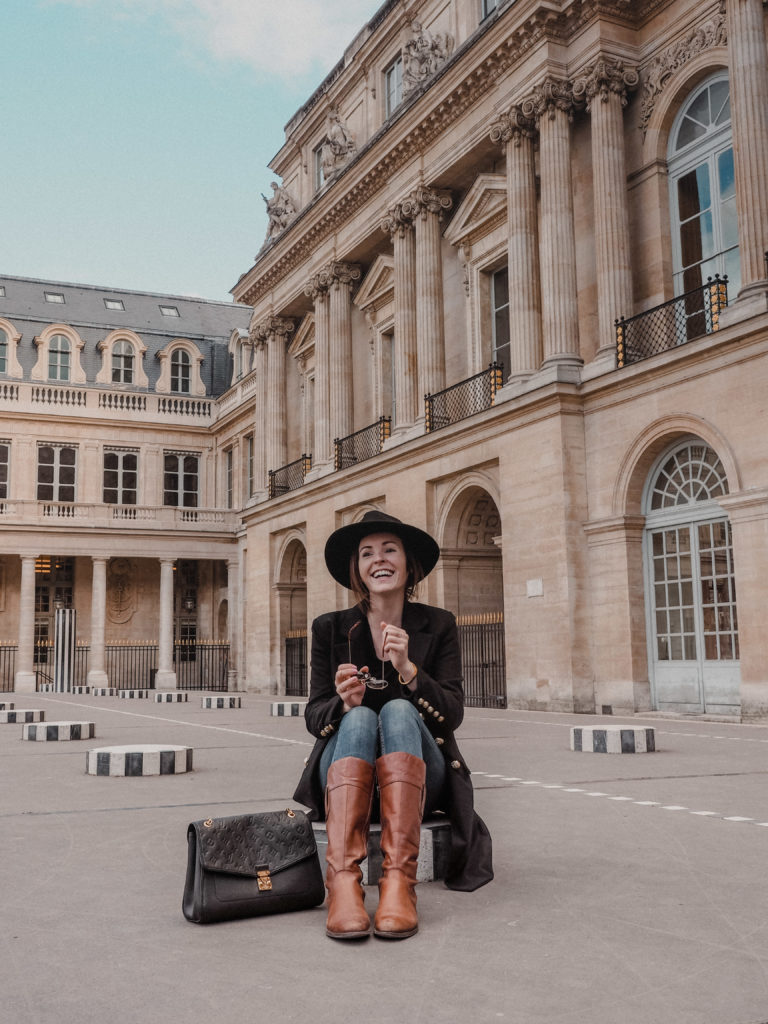
Wearing: Black and gold coat // Wesley Fedora Hat // Louis Vuitton Bag
The best tips for learning a new language
1. Pick the right app for your goal, not just the most popular one
Every language app is built around a different method, and matching that method to what you actually need matters more than picking whichever one is trending. Duolingo is gamified and built for daily habit-forming, which makes it great if you know you’ll only stick with something that feels like a game. Babbel is more structured and curriculum-based, with lessons built around real travel scenarios like ordering food or asking for directions, which makes it the one I’d recommend if your main goal is genuinely useful travel phrases rather than general fluency. Pimsleur is entirely audio-based and excellent if you want to be able to speak and understand spoken French quickly, particularly useful for the flight over. Rosetta Stone uses an immersive, visual, no-translation method, which suits people who learn best by doing rather than being explained the grammar. There’s no single best app, there’s a best app for how you personally learn and what you’re using it for.
2. Practise every day, even if it’s only ten minutes
Short, consistent sessions beat long, occasional ones. Fifteen to thirty minutes a day is the sweet spot most language learning research points to, because it keeps information moving into long-term memory rather than getting crammed and forgotten. I keep a standing half-hour most weekdays, and I’ve found that showing up daily matters far more than how long any single session runs.
3. Download your lessons for offline use before you fly
This sounds like a small thing, but it makes a real difference. Apps with solid offline access see meaningfully higher lesson completion rates, simply because you can keep practising on a plane, on a train, or anywhere with patchy signal, instead of losing momentum the moment you lose wifi. Download your lessons the night before a flight, not at the gate.
4. Start with the 100 most useful words, not the textbook basics
Every phrasebook starts you on “the pen is on the table.” Skip it. Learn the words that actually get used: numbers, directions, food and dietary words like “vegetarian” or “gluten-free,” “bathroom,” “help,” and basic pleasantries. These are the words you’ll reach for constantly once you’re actually there, and they’ll unlock far more real conversations than a page of grammar drills.
5. Talk to real people as early as possible
Apps will only take you so far. The fastest progress I’ve ever made with French has come from actually speaking it, badly, with real people, usually locals in Paris who are far more patient with my accent than I expect them to be. If you can’t get face-to-face practice before you travel, apps like italki connect you with native speakers and tutors for exactly this, or you can simply find a friend learning the same language and commit to practising together, like a gym buddy but for verb conjugations.
6. Work on your accent, not just your vocabulary
Knowing the words isn’t the same as being understood. I’ve found listening-based practice, repeating what you hear rather than just reading translations, does more for being understood locally than vocabulary memorisation alone. Audio-first tools like Pimsleur are particularly good for this, since you’re constantly hearing native speakers rather than reading text on a screen.
7. Build the language into your everyday life, not just study time
Swap “thank you” for “merci.” Greet people with “bonjour” instead of “hello.” Label things around your house in your target language if you want to get serious. These tiny habits keep the language present in your day outside of dedicated study time, which reinforces everything you’re learning in your actual lessons.
8. Look up words the moment you’re curious about them
The more you learn, the more you’ll find yourself wanting to know the word for something completely random, an object on your desk, a feeling, a specific food. Look it up on the spot rather than filing it away to check later, you’ll retain it far better in the moment than you will after the curiosity has faded. Most translation apps also let you hear the word spoken aloud, which doubles as pronunciation practice.
9. Push a little harder as you improve
Once the basics feel comfortable, it’s tempting to coast on easy daily lessons. Don’t. Progress tends to come from the harder sessions, the ones that genuinely challenge you, not the easy repeats. Mix in occasional longer, more intense study sessions alongside your daily practice once you’ve got some momentum behind you.
10. Consider one-on-one tutoring before a big trip
If you’ve got a major trip on the horizon and want to arrive with real conversational ability, one-on-one tutoring is the most efficient way to get there. You get direct, real-time correction and can ask the exact questions an app can’t answer. I’d recommend giving yourself at least a month of self-study first so you’re not walking into your first session completely cold.
11. Use the language the moment you land, not once you feel ready
You will never feel fully ready, and that’s fine. The single biggest jump in my own French happened simply from forcing myself to order in French, ask directions in French, and stumble through small talk in French from the moment I landed, rather than waiting until I felt confident enough. Locals are almost always more encouraging of the attempt than judgmental of the mistakes.
12. Treat an upcoming trip as your deadline, not a vague goal
“I’d like to learn French one day” rarely goes anywhere. “I land in Paris in eight weeks” absolutely does. Use your actual travel dates as a hard deadline for your learning, it gives every practice session a real purpose and makes it far easier to stay consistent when motivation dips.
Frequently Asked Questions
Do I need to be fluent before I travel? No. Fluency is a long-term goal, not a prerequisite for travel. A working vocabulary of common words, polite phrases, and travel-specific terms (directions, food, numbers, emergencies) will get you through the vast majority of real situations, and locals generally respond warmly to any genuine effort, imperfect grammar included.
How long does it take to learn basic travel phrases? With consistent daily practice of fifteen to thirty minutes, most people can build a genuinely useful travel vocabulary, greetings, numbers, directions, food and ordering, in four to six weeks. Full conversational comfort takes considerably longer, but that level of basic competency is realistic well before a typical trip.
What’s the best app to learn a language before a trip? It depends on your timeline and learning style. For fast, audio-first prep close to a trip, Pimsleur is hard to beat. For structured, travel-focused lessons over a longer runway, Babbel is a strong, well-rounded choice. For daily habit-building over months, Duolingo works well. For immersive, no-translation learning, Rosetta Stone suits people who learn best by doing rather than being taught grammar directly.
Is it better to use an app or find a tutor? Ideally both. Apps are the easiest entry point and great for daily consistency, but tutoring, conversation exchanges, and real immersion solve problems apps genuinely can’t, like natural conversation flow and accent correction. Most serious learners eventually combine an app for daily practice with some form of real human conversation.
A very warm thank you to Rosetta Stone for allowing me to realise my French speaking dreams! I look forward to checking back in with you all shortly with an update on my progress. While my course was gifted, all opinions are entirely my own.

Brooke Saward founded World of Wanderlust as a place to share inspiration from her travels and to inspire others to see our world. She now divides her time between adventures abroad and adventures in the kitchen, with a particular weakness for French pastries.
